
Balanced Parentheses Parser
Parse nested balanced parentheses structures, tracking depth and validating proper nesting. Demonstrates recursive structure handling.
Key Concepts
- recursive descent
- depth tracking
- balance validation
- tree structure
- nested content
Why Parse This Format?
Balanced delimiter parsing is fundamental to parsing programming languages, mathematical expressions, and any nested structure. It's a classic computer science problem with practical applications.
Use Cases
- Expression syntax validation
- Code editor bracket matching
- Mathematical expression parsing
- S-expression parsing
- Syntax highlighting support
Input Format
Text containing parentheses that must be properly balanced. Each opening '(' must have a matching closing ')'. Nesting is allowed.
balanced = text | ( balanced ) | balanced balancedExamples
()VALIDSimplest balanced pair
(())VALIDNested depth 2
((()))VALIDNested depth 3
(()())VALIDBranching structure
()()()VALIDSequential pairs
(text)VALIDContent inside parentheses
((text))VALIDNested with content
(()INVALIDInvalid: unclosed
())INVALIDInvalid: extra closing
Output Format
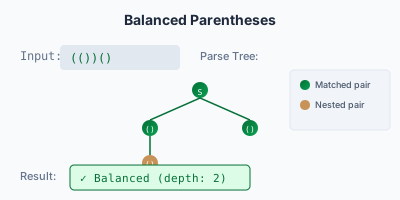
The parser returns a ParenNode enum representing the structure with depth tracking.
Structure
typeParenNode enum: Balanced { content: Box<ParenNode>, depth: usize }, Text(String), Empty(usize)
depthMaximum nesting depth can be calculated
Visual Overview
Rust
How the Code Works
Recursive Grammar Definition
.rule("balanced", choice(vec![
    dynamic(str("")),  // Empty - balanced
    dynamic(seq(vec![  // content
        dynamic(str("(")),
        dynamic(balanced),  // Recursive reference
        dynamic(str(")")),
        dynamic(balanced),
    ])),
]))
The grammar is self-referential - parentheses contain balanced content: A balanced string is either empty, or `(` + balanced + `)` + balanced.
Multiple Delimiter Types
.rule("paren_group", seq(vec![dynamic(str("(")), dynamic(content), dynamic(str(")"))]))
.rule("bracket_group", seq(vec![dynamic(str("[")), dynamic(content), dynamic(str("]"))]))
.rule("brace_group", seq(vec![dynamic(str("{")), dynamic(content), dynamic(str("}"))]))
Support for `()`, `[]`, and `{}`: Each delimiter type has its own rule, but they share the same content definition.
Validation Algorithm
fn validate_matching(input: &str) -> Result<(), String> {
    let mut stack: Vec<(char, usize)> = Vec::new();
    for (i, c) in input.chars().enumerate() {
        match c {
            '(' | '[' | '{' => stack.push((c, i)),
            ')' | ']' | '}' => {
                let expected = match c {
                    ')' => '(',
                    ']' => '[',
                    '}' => '{',
                    _ => return Err(format!("Unexpected closing '{}' at {}", c, i)),
                };
                match stack.pop() {
                    Some((open, pos)) if open == expected => continue,
                    Some((open, pos)) => return Err(format!("Mismatch: '{}' at {} vs '{}' at {}", open, pos, c, i)),
                    None => return Err(format!("Unmatched '{}' at {}", c, i)),
                }
            }
            _ => {}
        }
    }
    if !stack.is_empty() {
        return Err(format!("Unclosed '{}' at {}", stack[0].0, stack[0].1));
    }
    Ok(())
}
Post-parse validation checks matching delimiters: A stack-based approach ensures each opener has a matching closer of the same type.
Depth Tracking
fn calculate_depth(input: &str) -> usize {
    let mut max_depth = 0;
    let mut current_depth = 0;
    for c in input.chars() {
        match c {
            '(' | '[' | '{' => {
                current_depth += 1;
                max_depth = max_depth.max(current_depth);
            }
            ')' | ']' | '}' => current_depth -= 1,
            _ => {}
        }
    }
    max_depth
}
Track nesting depth for analysis: Maximum depth helps identify deeply nested structures.
//! Balanced Parentheses Parser Example
//!
//! This example demonstrates parsing nested balanced structures.
//! Shows handling of recursion and tree pattern matching.
//! Based on the Parslet parens.rb example.
//!
//! Run with: cargo run --example balanced_parens --no-default-features

#![allow(clippy::print_literal)]

use parsanol::portable::{
    parser_dsl::{choice, dynamic, re, seq, str, GrammarBuilder},
    AstArena, Grammar, PortableParser,
};

/// Build a balanced parentheses grammar
fn build_parens_grammar() -> Grammar {
    GrammarBuilder::new()
        // Balanced: ( balanced? )
        .rule(
            "balanced",
            choice(vec![
                dynamic(seq(vec![
                    dynamic(str("(")),
                    dynamic(re("[^()]*")), // Simple content (no nesting for now)
                    dynamic(str(")")),
                ])),
                dynamic(re("[^()]+")), // Non-paren text
            ]),
        )
        // Multiple balanced
        .rule("balanced_list", re("[^()]*(?:\\([^()]*\\)[^()]*)*"))
        .build()
}

/// Parentheses node
#[derive(Debug, Clone)]
pub enum ParenNode {
    /// Balanced pair with content
    Balanced {
        content: Box<ParenNode>,
        depth: usize,
    },
    /// Text content
    Text(String),
    /// Empty balanced pair
    Empty(usize),
}

impl std::fmt::Display for ParenNode {
    fn fmt(&self, f: &mut std::fmt::Formatter<'_>) -> std::fmt::Result {
        match self {
            ParenNode::Balanced { content, depth } => {
                write!(f, "{}({})", "  ".repeat(*depth), content)
            }
            ParenNode::Text(t) => write!(f, "{}", t),
            ParenNode::Empty(depth) => write!(f, "{}()", "  ".repeat(*depth)),
        }
    }
}

/// Parse balanced parentheses
pub fn parse_parens(input: &str) -> Result<ParenNode, String> {
    let grammar = build_parens_grammar();
    let mut arena = AstArena::for_input(input.len());
    let mut parser = PortableParser::new(&grammar, input, &mut arena);

    parser
        .parse()
        .map_err(|e| format!("Parse error: {:?}", e))?;

    // Manual parsing with depth tracking
    parse_with_depth(input, 0)
}

fn parse_with_depth(input: &str, depth: usize) -> Result<ParenNode, String> {
    let input = input.trim();

    if input.is_empty() {
        return Ok(ParenNode::Text(String::new()));
    }

    // Check for balanced pair
    if input.starts_with('(') && input.ends_with(')') {
        let inner = &input[1..input.len() - 1];
        if inner.is_empty() {
            return Ok(ParenNode::Empty(depth));
        }
        let content = parse_with_depth(inner, depth + 1)?;
        return Ok(ParenNode::Balanced {
            content: Box::new(content),
            depth,
        });
    }

    // Text content
    Ok(ParenNode::Text(input.to_string()))
}

/// Calculate the maximum nesting depth
pub fn max_depth(input: &str) -> usize {
    let mut max: usize = 0;
    let mut current: usize = 0;

    for c in input.chars() {
        match c {
            '(' => {
                current += 1;
                max = max.max(current);
            }
            ')' => {
                current = current.saturating_sub(1);
            }
            _ => {}
        }
    }

    max
}

/// Check if parentheses are balanced
pub fn is_balanced(input: &str) -> bool {
    let mut count = 0;

    for c in input.chars() {
        match c {
            '(' => count += 1,
            ')' => {
                if count == 0 {
                    return false;
                }
                count -= 1;
            }
            _ => {}
        }
    }

    count == 0
}

fn main() {
    println!("Balanced Parentheses Parser Example");
    println!("===================================\n");

    let examples = [
        ("()", true, 1),
        ("(())", true, 2),
        ("((()))", true, 3),
        ("(()())", true, 2),
        ("()()()", true, 1),
        ("(())(())", true, 2),
        ("(()", false, 0),   // Unbalanced
        ("())", false, 0),   // Unbalanced
        ("((())", false, 0), // Unbalanced
        ("text", true, 0),
        ("(text)", true, 1),
        ("((text))", true, 2),
    ];

    println!(
        "{:<15} | {:<10} | {:<10} | {}",
        "Input", "Balanced?", "Max Depth", "Status"
    );
    println!("{}", "-".repeat(60));

    for (input, expected_balanced, expected_depth) in examples {
        let balanced = is_balanced(input);
        let depth = max_depth(input);
        let status = if balanced == expected_balanced && depth == expected_depth {
            "✓"
        } else {
            "✗"
        };
        println!(
            "{:<15} | {:<10} | {:<10} | {}",
            input, balanced, depth, status
        );
    }

    // Parse tree visualization
    println!("\nParse Tree Examples:");
    println!("--------------------");

    let tree_examples = ["()", "(())", "((()))", "(()())"];

    for input in tree_examples {
        println!("\n{}:", input);
        match parse_parens(input) {
            Ok(node) => print_node(&node, 0),
            Err(e) => println!("  Error: {}", e),
        }
    }
}

fn print_node(node: &ParenNode, indent: usize) {
    let pad = "  ".repeat(indent);
    match node {
        ParenNode::Balanced { content, depth } => {
            println!("{}Balanced (depth={}):", pad, depth);
            print_node(content, indent + 1);
        }
        ParenNode::Text(t) => {
            println!("{}Text: {:?}", pad, t);
        }
        ParenNode::Empty(depth) => {
            println!("{}Empty (depth={})", pad, depth);
        }
    }
}
Ruby
How the Code Works
Recursive Balanced Rule
rule(:balanced) {
  str('(').as(:l) >> balanced.maybe.as(:m) >> str(')').as(:r)
}
Parentheses are defined recursively: Each level contains opening paren, optional nested content, and closing paren.
Labeled Components
str('(').as(:l)    # Opening paren labeled :l
balanced.maybe.as(:m)  # Middle content labeled :m
str(')').as(:r)    # Closing paren labeled :r
Each part is labeled for pattern matching: Labels enable precise pattern matching in transforms.
Transform for Counting
class Transform < Parsanol::Transform
  rule(:l => '(', :m => simple(:x), :r => ')') {
    x.nil? ? 1 : x+1
  }
end
The transform counts nesting depth: Pattern matches the structure; nil indicates innermost level.
Recursive Tree Structure
# Input: ((()))
# Tree: {:l=>"(", :m=>{:l=>"(", :m=>{:l=>"(", :m=>nil, :r=>")"}, :r=>")"}, :r=>")"}
Deep nesting creates nested parse trees: The innermost `:m` is nil when nothing is inside.
Recursive Tree Structure
# Input: ((()))
# Tree: {:l=>"(", :m=>{:l=>"(", :m=>{:l=>"(", :m=>nil, :r=>")"}, :r=>")"}, :r=>")"}
Deep nesting creates nested parse trees: The innermost `:m` is nil when nothing is inside.
# frozen_string_literal: true

# A small example that demonstrates the power of tree pattern matching. Also
# uses '.as(:name)' to construct a tree that can reliably be matched
# afterwards.

$LOAD_PATH.unshift "#{File.dirname(__FILE__)}/../lib"

require "pp"
require "parsanol/parslet"

# as in 'lots of insipid and stupid parenthesis'
module LISP
  class Parser < Parsanol::Parser
    rule(:balanced) do
      str("(").as(:l) >> balanced.maybe.as(:m) >> str(")").as(:r)
    end

    root(:balanced)
  end

  class Transform < Parsanol::Transform
    rule(l: "(", m: simple(:x), r: ")") do
      # innermost :m will contain nil
      x.nil? ? 1 : x + 1
    end
  end
end

parser = LISP::Parser.new
transform = LISP::Transform.new
%w[
  ()
  (())
  ((((()))))
  ((())
].each do |pexp|
  begin
    result = parser.parse(pexp)
    puts "#{'%20s' % pexp}: #{result.inspect} (#{transform.apply(result)} parens)"
  rescue Parsanol::ParseFailed => e
    puts "#{'%20s' % pexp}: #{e}"
  end
  puts
end
Ruby(parens)
# frozen_string_literal: true

# A small example that demonstrates the power of tree pattern matching. Also
# uses '.as(:name)' to construct a tree that can reliably be matched
# afterwards.

$LOAD_PATH.unshift "#{File.dirname(__FILE__)}/../lib"

require "pp"
require "parsanol/parslet"

# as in 'lots of insipid and stupid parenthesis'
module LISP
  class Parser < Parsanol::Parser
    rule(:balanced) do
      str("(").as(:l) >> balanced.maybe.as(:m) >> str(")").as(:r)
    end

    root(:balanced)
  end

  class Transform < Parsanol::Transform
    rule(l: "(", m: simple(:x), r: ")") do
      # innermost :m will contain nil
      x.nil? ? 1 : x + 1
    end
  end
end

parser = LISP::Parser.new
transform = LISP::Transform.new
%w[
  ()
  (())
  ((((()))))
  ((())
].each do |pexp|
  begin
    result = parser.parse(pexp)
    puts "#{'%20s' % pexp}: #{result.inspect} (#{transform.apply(result)} parens)"
  rescue Parsanol::ParseFailed => e
    puts "#{'%20s' % pexp}: #{e}"
  end
  puts
end
Use it from TypeScript (WebAssembly)
The same grammar runs in the browser through the shipped wasm engine — checksum-verified load, parse with recovery, typed bindings:
import { initSync, PargArtifactJs } from "@parsanol/wasm";

// Browser: await init() — Node: initSync(readFileSync(wasmPath))
initSync(readFileSync(wasmPath));

const artifact = new PargArtifactJs(artifactJson); // checksum verified on load

// Parse with recovery: deepest position, partial tree, resync spans
const envelope = JSON.parse(artifact.parseShapeRecovering(entry, input));

// Bind captures to your model
const bound = artifact.applyBindings(entry, JSON.stringify(envelope.shape));
Compile the grammar with the Ruby compiler, load the artifact anywhere — and see the playgroundrun the shipped wasm engine live. The artifact's embedded tests replay on every engine, so the tree you get is the tree everyone gets.