
S-Expression Parser
Parse S-expressions (symbolic expressions), the nested list structure used in Lisp-family languages. Supports symbols, numbers, strings, and nested lists.
Key Concepts
- recursive grammar
- atom types
- list structure
- nested parsing
- code-as-data
Why Parse This Format?
S-expressions are a fundamental data structure in Lisp languages and are used for code-as-data representation, configuration files, and data interchange in functional programming communities.
Use Cases
- Lisp/Scheme interpreter implementation
- Configuration file parsing
- Code transformation tools
- Symbolic computation
- Data serialization
Input Format
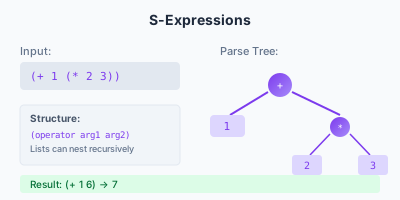
S-expressions are recursively defined: atoms (symbols, numbers, strings) or lists of s-expressions in parentheses. Whitespace separates elements.
sexp = atom | ( sexp* ) where atom = symbol | number | "string"Examples
42VALIDNumber atom
-3.14VALIDNegative float atom
helloVALIDSymbol atom
"hello world"VALIDString atom
(+ 1 2)VALIDSimple list (addition)
(+ (* 2 3) (- 10 5))VALIDNested lists
(defun factorial (n) (if (<= n 1) 1 (* n (factorial (- n 1)))))VALIDFunction definition
(list 1 2 3 "four" (quote five))VALIDMixed types in list
(unclosedINVALIDInvalid: missing closing paren
Output Format
The parser returns an SExp enum representing the expression tree with proper type distinctions.
Structure
SExpEnum: Symbol(String), Int(i64), Float(f64), String(String), List(Vec<SExp>)
ListRecursive structure containing nested SExp values
Visual Overview
How the Code Works
This section explains how the parsing rules map to the format semantics.
Atom Parsing
.rule("symbol", re("[a-zA-Z_+\\-*/=<>!][a-zA-Z0-9_+\\-*/=<>!]*"))
.rule("number", re("-?[0-9]+(\\.[0-9]+)?"))
.rule("string", re("\"[^\"]*\""))

.rule(
    "atom",
    choice(vec![
        dynamic(re("[a-zA-Z_+\\-*/=<>!][a-zA-Z0-9_+\\-*/=<>!]*")),  // symbol
        dynamic(re("-?[0-9]+(\\.[0-9]+)?")),                        // number
        dynamic(re("\"[^\"]*\"")),                                  // string
    ]),
)
Atoms are the primitive values in S-expressions: Symbols can include operator characters (`+`, `-`, `*`, etc.) for Lisp-style operators.
List Parsing
.rule(
    "list",
    seq(vec![
        dynamic(str("(")),
        dynamic(re("[ \t\n\r]*")),  // optional whitespace
        dynamic(re("\\)*")),         // items (simplified)
        dynamic(str(")")),
    ]),
)
Lists are parenthesized sequences:
Recursive Parsing
fn parse_sexp_list(input: &str) -> Result<Vec<SExp>, String> {
let mut items = Vec::new();
let mut depth = 0;
let mut current = String::new();
for c in input.chars() {
match c {
'(' => {
depth += 1;
current.push(c);
}
')' => {
depth -= 1;
current.push(c);
}
' ' | '\t' | '\n' | '\r' if depth == 0 => {
if !current.is_empty() {
items.push(parse_sexp(¤t)?);
current.clear();
}
}
_ => current.push(c),
}
}
Ok(items)
}S-expressions are parsed recursively by tracking nesting depth: When depth is 0 and whitespace is found, the current item is complete.
Value Detection
pub fn parse_sexp(input: &str) -> Result<SExp, String> {
    if input.starts_with('(') && input.ends_with(')') {
        return Ok(SExp::List(parse_sexp_list(inner)?));
    }
    if input.starts_with('"') && input.ends_with('"') {
        return Ok(SExp::String(input[1..len-1].to_string()));
    }
    if let Ok(n) = input.parse::<i64>() {
        return Ok(SExp::Int(n));
    }
    if let Ok(n) = input.parse::<f64>() {
        return Ok(SExp::Float(n));
    }
    Ok(SExp::Symbol(input.to_string()))
}
Values are detected by their format:
Source Code
//! S-Expression Parser Example
//!
//! This example demonstrates parsing S-expressions (Lisp-style syntax).
//! Shows recursive grammar definition and nested structure handling.
//!
//! Run with: cargo run --example sexp_parser --no-default-features
#![allow(clippy::get_first)]
#![allow(clippy::single_match)]
use parsanol::portable::{
parser_dsl::{choice, dynamic, re, seq, str, GrammarBuilder},
Grammar,
};
/// Build an S-expression grammar
#[allow(dead_code)]
fn build_sexp_grammar() -> Grammar {
GrammarBuilder::new()
// Whitespace (spaces, tabs, newlines)
.rule("whitespace", re("[ \t\n\r]+"))
// Atom: symbol or number
.rule("symbol", re("[a-zA-Z_+\\-*/=<>!][a-zA-Z0-9_+\\-*/=<>!]*"))
.rule("number", re("-?[0-9]+(\\.[0-9]+)?"))
.rule("string", re("\"[^\"]*\""))
// Atom: any of the above
.rule(
"atom",
choice(vec![
dynamic(re("[a-zA-Z_+\\-*/=<>!][a-zA-Z0-9_+\\-*/=<>!]*")),
dynamic(re("-?[0-9]+(\\.[0-9]+)?")),
dynamic(re("\"[^\"]*\"")),
]),
)
// List: (items...)
.rule(
"list",
seq(vec![
dynamic(str("(")),
dynamic(re("[ \t\n\r]*")), // optional whitespace
dynamic(re("\\)*")), // items (simplified)
dynamic(str(")")),
]),
)
// S-expression: atom or list
.rule(
"sexp",
choice(vec![
dynamic(re("[a-zA-Z_+\\-*/=<>!][a-zA-Z0-9_+\\-*/=<>!]*")),
dynamic(re("-?[0-9]+(\\.[0-9]+)?")),
dynamic(re("\"[^\"]*\"")),
dynamic(seq(vec![
dynamic(str("(")),
dynamic(re("[^)]*")), // content
dynamic(str(")")),
])),
]),
)
.build()
}
/// S-expression value
#[derive(Debug, Clone)]
pub enum SExp {
/// Symbol (identifier)
Symbol(String),
/// Integer number
Int(i64),
/// Floating point number
Float(f64),
/// String literal
String(String),
/// List of S-expressions
List(Vec<SExp>),
}
impl std::fmt::Display for SExp {
fn fmt(&self, f: &mut std::fmt::Formatter<'_>) -> std::fmt::Result {
match self {
SExp::Symbol(s) => write!(f, "{}", s),
SExp::Int(n) => write!(f, "{}", n),
SExp::Float(n) => write!(f, "{}", n),
SExp::String(s) => write!(f, "\"{}\"", s),
SExp::List(items) => {
write!(f, "(")?;
for (i, item) in items.iter().enumerate() {
if i > 0 {
write!(f, " ")?;
}
write!(f, "{}", item)?;
}
write!(f, ")")
}
}
}
}
/// Parse an S-expression string
pub fn parse_sexp(input: &str) -> Result<SExp, String> {
let input = input.trim();
// Empty
if input.is_empty() {
return Err("Empty input".to_string());
}
// List
if input.starts_with('(') && input.ends_with(')') {
let inner = &input[1..input.len() - 1];
let items = parse_sexp_list(inner)?;
return Ok(SExp::List(items));
}
// String
if input.starts_with('"') && input.ends_with('"') {
return Ok(SExp::String(input[1..input.len() - 1].to_string()));
}
// Number
if let Ok(n) = input.parse::<i64>() {
return Ok(SExp::Int(n));
}
if let Ok(n) = input.parse::<f64>() {
return Ok(SExp::Float(n));
}
// Symbol
if input
.chars()
.all(|c| c.is_alphanumeric() || "+-*/_=<>!".contains(c))
{
return Ok(SExp::Symbol(input.to_string()));
}
Err(format!("Invalid S-expression: {}", input))
}
/// Parse a list of S-expressions (inner content of parentheses)
fn parse_sexp_list(input: &str) -> Result<Vec<SExp>, String> {
let mut items = Vec::new();
let mut chars = input.chars().peekable();
let mut current = String::new();
let mut depth = 0;
while let Some(c) = chars.next() {
match c {
'(' => {
depth += 1;
current.push(c);
}
')' => {
depth -= 1;
current.push(c);
}
'"' => {
current.push(c);
// Read until closing quote
while let Some(&next) = chars.peek() {
current.push(chars.next().unwrap());
if next == '"' {
break;
}
}
}
' ' | '\t' | '\n' | '\r' if depth == 0 => {
if !current.is_empty() {
items.push(parse_sexp(¤t)?);
current.clear();
}
}
_ => {
current.push(c);
}
}
}
if !current.is_empty() {
items.push(parse_sexp(¤t)?);
}
Ok(items)
}
fn main() {
println!("S-Expression Parser Example");
println!("===========================\n");
let expressions = [
"42",
"-3.14",
"hello",
"\"hello world\"",
"(+ 1 2)",
"(+ (* 2 3) (- 10 5))",
"(defun factorial (n) (if (<= n 1) 1 (* n (factorial (- n 1)))))",
"(list 1 2 3 \"four\" (quote five))",
];
for expr in expressions {
println!("Input: {}", expr);
match parse_sexp(expr) {
Ok(sexp) => {
println!("Parsed: {}", sexp);
println!("Debug: {:?}", sexp);
}
Err(e) => println!("Error: {}", e),
}
println!();
}
// Demonstrate evaluation
println!("Simple Evaluation Demo:");
println!("-----------------------");
let expr = "(+ (* 2 3) (- 10 5))";
match parse_sexp(expr) {
Ok(SExp::List(items)) => {
println!("Expression: {}", expr);
println!("Operator: {:?}", items.first());
println!("Operands: {:?}", &items[1..]);
if let Some(SExp::Symbol(op)) = items.first() {
if op == "+" {
let sum: i64 = items[1..]
.iter()
.filter_map(|x| if let SExp::Int(n) = x { Some(*n) } else { None })
.sum();
println!("Sum of integers: {}", sum);
}
}
}
_ => {}
}
}